One of my first memories is myself, 5 years old, going to my mother and declare to her, as serious as only children can be: “I will be a scientist.”
Yesterday night I was in my office in the Department of Chemistry at the University of Cambridge packing my stuff, resolved to not go back to research again -at least not in the shortcoming future.
What has gone wrong?
I could write in detail what was horribly wrong with my project, and for sure having a lousy project played a big part in deciding to stop and change my path. You for sure want to change your path if you find yourself in a mosquito-ridden swamp.
But if this was the only problem, I would have simply switched to another lab. That’s what I thought until not too long ago (even if the idea of quitting was really in my mind since a lot of time). But the problem is the practice of science itself.
Don’t get me wrong. Every scientist goes on to do science for a single reason: the love of science. Science doesn’t make you rich, it doesn’t make you famous (can you tell me the last 5 Nobel Prizes for chemistry without looking on Wikipedia? I can’t either) and doesn’t make you comfortable. The only sane reason for starting to do science is the dispassionate love of science itself. And I loved science. Like nothing else. Since I was 5 years old. And I still love it.
But one thing is to love science; a completely different one is doing it. Like the proverbial sausage, you don’t want to know how it’s done.
Actually, doing science per se is great. Doing experiments, analyzing data, making calculations, programming code: I loved it all immensely.
However, with the partial exception of mathematics and theoretical physics, you can’t be a lone wolf in science. You need funding, you need instruments, you need resources. You need other people. And here’s where the problems lie. You basically face two choices.
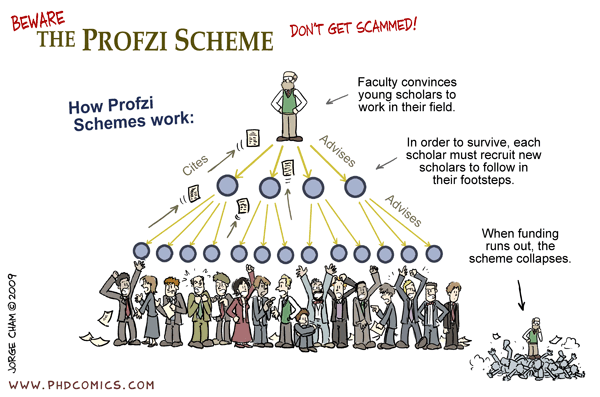
No, it's not a satire or an exaggeration.
The first is going for the sky: doing great science in a first-class place, make a great curriculum and look for a tenured position in the end. The problem is that a lot of clever people want to go for the sky, and there is much more people who want the sky compared to the available positions. In general, science career is a race, where three people go to the podium and all the others sooner or later will go back home (See also this article from the Economist on the problem). The competition for funding and positions means that not only the hopes of getting a job are really lousy, but that people become nasty. Like, really nasty.
I know of people that have given a purportedly crippled software to a collegue to sabotage his project. I’ve been violently attacked verbally for having dared talking with my supervisor of a project I was collaborating with, because she feared that I wanted to “steal” her credit. And I can’t blame her: she was “helped” by another postdoc when she first came in Cambridge, only to find all credit for her work taken by the nice and smiling guy who scammed her by “helping” her. There are endless horror stories like that. Everywhere. Now, do you want to work in a place full of insanely clever people who are also insanely cynical and determined to do everything to get on top of you? If so, you can do top level science.
It’s not all, of course. Top level science requires also an absolutely mind-boggling determination and, overall, confidence in yourself. To properly do science you must be absolutely sure that, whatever you have in mind, you will do it, no matter what, and that you’re doing it right, to the point of almost self-delusion. This is so important that who wins in science is regularly not the most brilliant but the most determined (I’ve seen Nobel prizes speaking and half of the times they didn’t look much more brilliant than your average professor. Most of them were just lucky, and overall were incredibly, monolithically determined). Combined with the above, this means working 24/7, basically leaving behind everything in your life, without any doubt on your skills and abilities and most importantly on your project, while fencing off a competition of equally tough, confident and skilled guys.

A friendly post-doctoral scientist in your group asking for a scientific collaboration.
The ones I’ve seen thriving in Cambridge, apart from geniuses (there are a few), are the guys who cling to a simple ecological tenet: Find your niche, where you are indispensable, and keep it in your claws at all costs. This means basically that these people do always the same thing, over and over again, simply because it’s the lowest-risk option. I could have done the same (I was pretty skilled during my Ph.D. in a quite obscure but interesting biophysics experimental technique) but I thought that doing science properly was also about learning and broadening your expertise. How wrong I was.
You can imagine yourself what does it mean also for research in general: Nobody takes risks anymore. Nobody young jumps and tries totally new things, because it’s almost surely a noble way to suicide your career.
There is a second option, which is bare survival. You go from postdoc to postdoc, perhaps end up as a long-term researcher somewhere in some tiny university or irrelevant research center (like CNR in Italy) and basically spend your time with a low pay, working on boring projects, crippled by lack of funding and without any hope of a reasonable career (because the career path is taken over by the hawks above described), nor any hope of stability in your life.
Notice that, again, both paths do not offer you any guarantee of sort. You can arrive to tenure track (itself an achievement) and being kicked out after a few years, thus ending up as a jobless 40-year something, with a family probably, too old to compete in the market of real jobs. And bare survival is not easy as well.
So basically, if you are not cut for this kind of life, your chances are zero. I tried, believe me. I tried hard. What happened during my research career is that I spent 6 months on antidepressants, I got a permanent gastritis, I wasted at least two important sentimental relationships, and I found all my interests and social life going down the drain.
All of this for having a couple papers about modeling obscure aspects of protein behaviour, papers that will be probably lost within the literally thousands of papers that come out every day? Until not so long, I thought that it was worth it. It was something that I had never questioned so far. I wanted to be a scientist since when I was five. I had done everything to become a scientist. I was a scientist in one of the top universities of the world, in one of the top five research groups on the subject. I had won a personal fellowship to fund myself. Most of my self-esteem, of my very concept of self-realization, relied on myself being a scientist. The very idea of quitting academia was a synonim of personal failure.
It has been long and painful to discover that it was just an illusion. When I found that academia was not working for me, I got immediately depressed -my whole worldview was crumbling. Then I remembered that I had a life. I liked my life. I had a billion things that I loved to do. I want to do them again. Quitting and reclaiming back your life is not failing. It is waking up and winning.
A week ago I was with friends, talking about my job, and I found myself comparing science to a drug addiction. Being a scientist, from the brain chemicals point of view, is one week of adrenaline rush when you’re finally on to something and pieces go together -followed by six months (if you are lucky) of pain and suffering, only to get again that adrenaline shot.
Well, noble addiction as it is, it is toxic the same. The next month I’ll be 30. It’s really time to get my life back.
Good luck to you, mate! It takes serious strength to stop, look around, and realise that where you are is all wrong. I hope whatever you do next works out well!
This reminded me of the monologue from The Curious Case of Benjamin Button:
“For what it’s worth -it’s never too late or, in my case, too early to be whoever you want to be. There’s no time limit, stop whenever you want. You can change or stay the same, there are no rules to this thing. We can make the best or the worst of it. I hope you make the best of it -I hope you see things that startle you. I hope you feel things you never felt before. I hope you meet people with a different point of view. I hope you have a life you’re proud of -If you find that you’re not, I hope you have the strength to start all over again.”
Here’s to the coexistence of disillusionment and sanity! ;]
It is a pity to see a motivated researcher give in to an insane society, which relies on but is not build upon science.
You may find further clarity and solace in “The Structure of Scientific Revolutions” by Thomas Kuhn. Highly recommended by someone who’s been in your place. It really should be required reading for all grad school applicants in sciences.
Good luck Massimo. I also have clear that this is not more than a ponzi scheme where they make us run and run like rats towards a statistically very poor cheese.
Fortunately my group does not show too much cutthroat competition, but if I look to nearby groups… Not to talk about the absolutely fake results that are fabricated to land a couple of quick publications. It just defeats the whole purpose of science.
Greetings from an old force spectroscopist (you know
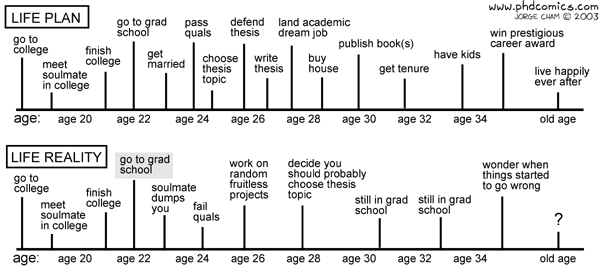
I don’t remember seeing that “Life plan” comic from PHD Comics but when I landed in your blog, that was the first thing that got my attention — it’s so true, just as the rest of your post, so true it’s disturbing.
I am 30-years old, still with a PhD to finish and now-and-then, when I wake up in the middle of the night after another nightmare I wonder whether it is still worth the trouble. Hopefully I got into my “dream job” out of academia but the regret of not having finished the PhD yet is killing the dream.
The wide world is waiting for you - and in the wide world it’s useful to have a scientist’s critical eye and inquiring mind. Go get ‘em.
[...] This post was mentioned on Twitter by TiagoMacambira, Domenico Polimeno, Convo.ru, Alexander, m.y.ikegami_bot and others. m.y.ikegami_bot said: Goodbye to academic research http://goo.gl/fb/c58ID [...]
I’m about 9 months into a lab tech job. It was supposed to be a slight break from school but ultimately lead me to applying to a Ph.D program. I hate my project. I have no motivation to read into it and push myself with it. I don’t want to be here past 5pm. Ever. My boss basically told me that he will only write me a letter of recommendation if I apply to a Grad program.
I have no idea what I am going to do now. I’m now realizing I got into science because I saw it as a steady flow of cash. Not a lot of money, but enough that I wouldn’t be in debt like my parents. I have a year left on my contract and my boss is just getting pissed at me. I’m so lost.
Thanks for writing this.
Good Luck to you in whatever you are doing next! Thank you for the eye opening post.
I hope you will continue giving updates of where you finally landed up or what job avenues lie in front of you.
As much as I believe that what you say is true, I would also like you to propose solutions for people stuck similarly in the whirlwind.
Any field of excellence you may choose, there will always be hawks of the type you described. It is after all a dog eat dog world and the ‘fittest’ survive. In your specific case, survival might mean re-inventing yourself by changing careers. So be it.
Went through a similiar experience. I had wanted to teach for as long as I can remember. But I was so unhappy in the academic environment. When that door finally closed, I was happier than I had been in years. I realized that there is a world of opportunity out there and many fun, challenging projects to work on.
Good luck to you!
To be a scientist does not mean you have to work in the field of science.
Don’t let people shame you about quitting.
Some people who have never been in academia will tell you that you wasted all that time and you were so close.
The ones who haven’t quit will try to justify their own terrible lives by putting you down.
Don’t let any of those people make you regret that you remembered who you really are. Best of luck!
You have just passed your prelim. Now go get the degree and do something fun with it like start a company, sell high end physics instruments or write a chemistry based novel - maybe something zombies.
Every Ph.D. student needs to get where you are to get out. The idealists fail later in the process.
Don’t even count Mathematics as a lone wolf endeavour: we still need funding, money or at least a table and pens (a good computer is a bonus). I’m doing my PhD now (well, for the last 6 years, that is), and the best prospect after finishing my thesis (which should be in the next 12 months) is just getting out of academia and finding a “real” job.
I could, of course, do post-doc juggling as some of my colleagues are doing. Which will mean, in the best case, that I may have a 4-year position when I’m at least 35. I will have no kind of stability until at least 40. It is not a good way of living.
For those who think that in a “real business” you don’t have security either, don’t get me wrong, but it is completely different. In a corporate job you get fired, spend maybe one or two months looking for new jobs, and if you know your stuff, you will find a job again. In academia, once your post-doc is finished, you may be uneligible for another of the same type, or just end when the next coming up is in 6 months, or just don’t meet the requirements unless you like living in St. Petersburg (which I bet is a lovely city, just was a random city name).
I drawed an image of how I was seeing my future: Future in Mathematics (link to my personal blog). Feel free to disagree… or to post it here as another affirmation of non-expectations
Cheers,
Ruben
Very insightful. And I know for a fact there are many people like you out there. Some I know made the jump out of science because luckily their family was more important, but some are still striving for the meager life you’re describing. Sigh. Good luck to you, though I’m not that worried. Pharmaceutics companies look kindly on talented chemists…
I had a similar experience:
I also wanted to be a scientist since I’m five.
I also failed not because of my abilities nor my faith, but because of the Academic system.
But, in the end my experience is mostly positive. I have a good job, good pay, and a _lot_ of time. I am so over-qualified I can finish a 15 days work in 4 hours.
I sometime reminds my old scientist life. I tend to regret not teaching anymore. I tend to regret not talking with scientist about my research. But I also remind how hard it was to have time for my wife and children. How lived being only 10% up to the threshold of being considered poor. I remind how I almost loosed my wife and family because of my depression due to my failure. And I feel nice. In the end I know I did the right choice. I simply regret not having quit sooner.
I also loosed science, but I gained life.
Start seeing things positively.
You have a Ph.D. => You are smart. Not any remark about your abilities should affect you now.
You had the chance to do what you really loved for some time. 99.9% of people didn’t had such a chance.
A lot of “not scientific” stuff is also completely enjoyable. I am sure you’ll find your way.
I wish you the best.
Hi there, sounds like we are on the same boat except that I have not been in elite school/lab. I find our thoughts are almost in sync with each other. I guess despite deciding to quit science altogether, I am sure you had your joy working at such a top-notch lab, which should itself be a hell of an experience.
Among all that you mentioned, another frustrating thing in academic arena is to deal with someone who think they are king, who don’t seem to listen to novice, who beat around the bush, who claim they are good because they got fundings. It’s the worst case scenario.
Anyways, like you said, science is fantastic but is something that takes tremendous perseverance and guts to pursue.
Best wishes to your future endeavors. Truly hope there will be something that we all ultimately like working on lying ahead.
Don’t worry - those Indian and Chinese will love to take your opportunity. They are right behind you. Go on and enjoy your life. If life will have its course, much like in the Arab world, your race will adapt you and give you higher managerial seat with mediocre knowledge and get those Indian and Chinese to work for you.
Thumbs up. I also quit two days ago in my 35 year and 13 y working in academia. I’d rather drive a truck or clean the streets than stay.
Best of luck to you as well - 30 is still very young to start and achieve anything.
I come from a family of academics and avoided it myself for the very reasons you mentioned but on the bright side, I think you’ll soon find that doors will open with your great credentials.
There is a great scene in Atlas Shrugged where a great scientist walks out on his mentor because he agrees to create this state-sponsored institute for science. Perhaps science for it’s own sake has some place in society, but everytime I poke around, most academics are so lost in their own specialties that they’re far removed from the real needs of people - perhaps in industry you can find more meaning to the skills you’ve developed.
Joseph Campbell in 1987, at age 83:
Poets are simply those who have made a profession and a lifestyle of being in touch with their bliss. Most people are concerned with other things. They get themselves involved in economic and political activities, or get drafted into a war that isn’t the one they’re interested in, and it may be difficult to hold to this umbilical under those circumstances. That is a technique each one has to work out for himself somehow.
But most people living in that realm of what might be called occasional concerns have the capacity that is waiting to be awakened to move to this other field. I know it, I have seen it happen in students.
When I taught in a boys’ prep school, I used to talk to the boys who were trying to make up their minds as to what their careers were going to be. A boy would come to me and ask, “Do you think I can do this? Do you think I can do that? Do you think I can be a writer?”
“Oh,” I would say, “I don’t know. Can you endure ten years of disappointment with nobody responding to you, or are you thinking that you are going to write a best seller the first crack? If you have the guts to stay with the thing you really want, no matter what happens, well, go ahead.”
Then Dad would come along and say, “No, you ought to study law because there is more money in that, you know.” Now, that is the rim of the wheel, not the hub, not following your bliss.
Are you going to think of fortune, or are you going to think of your bliss?
I came back from Europe as a student in 1929, just three weeks before the Wall Street crash, so I didn’t have a job for five years. There just wasn’t a job. That was a great time for me.
you have the bravery of 10 lions. I wish you the best of luck and I hope to see you with a Noble Prize one day!
“You for sure want to change your path if you find yourself in a mosquito-ridden swamp.”
This is personally funny as my plan was to become a Bible translator and my peers are in fact in mosquito-ridden swamps as that is where the last few language groups without translations are. Ah! But the realities of life has kept me from it.
Replace the opening paragraph with any of the following: One of my first memories is myself, 5 years old, going to my mother and declare to her, as serious as only children can be: “I will be a film star/astronaut/president.”
Now you have the modern existentialist crisis with a culture that values the individual. This focus on the individual stems from the post-industrial need for commodication. The pinnacle of this was slavery.
In practical terms, you are live in a system that covets the individual, but only at the cost of all other individuals. This paradigm is slowly being de-valued with the intense dilution of Western ideology. You won’t live to see a time when it no long holds any currency, but fret not, brother, for we are just all drops of water in a very large ocean. Sometimes we are the tide, and sometimes we are the rain.
You’re finally following the path of the winner.
Winners fail fast so they can correct their course.
Good luck. Try to recognize that it may not be the field, but the level that is causing you problems. Working in an investment bank is the same, only much more so. Being a top level athlete or politician as well. Just because you have the talent to be a super high achiever doesn’t mean you have the temperament (as since the temperament is “single-minded sociopath” that’s not a bad thing), so making peace with that could be what you really need.
You’ve already accomplished so much in the eyes of many. You’re an extremely skilled individual and I’m sure you’ll be able to do fine in any number of non-academic fields. Your resume already sounds fantastic, so go out and enjoy life with a regular 9-5 like everyone else. Its worth it.
It may be an over-pessimistic account of “doing science”. After all, plenty of people enjoy doing science as a career (hence the level of competition), and I know plenty of people suffer in “real jobs”.
Wow. That’s a wonderful article. Thank you. I just came to a realization a few weeks back that quitting research mathematics was the best decisions I’ve ever made in my entire life, and it’s great that there are other folks who support that and not just academics who sneer at folks like us, calling us failures. Kudos to you.
I hit that point before I even got to my Quals. I opted to leave with a Masters degree, which has left me in a bit of a lurch jobwise as well because there are very few positions that are looking for people with my skillset and background. I’m either overqualified or underqualified.
I left grad school in 2008 and have only JUST gotten a job in the public sector (government) and even that is reliant on funding and will go away in September if the grant isn’t renewed. But the science I’m doing now is worth it. I get to help keep the public healthy and that, to me, is a worthy endeavour (and comes with an 8-5 schedule )
)
Hey,
You are only thirty - get the fuck over it. I got my PhD, did a postdoc, thought oh my god wtf am I doing here an changed career track completely to go corporate. Now I am a young pup too innovative not to piss a few people off.
You just feel old because you have been working in a uni.
It’s cut throat in molecular biology and a lot of other fields. There is a lot of fraud, a lot of back-stabbing (routine to cripple cultures, routine to Photoshop images, routine to steal data, routine to have to use commercial products that are the result of all of the above and generally expensive but worthless, etc.).
This is why molecular biology and related fields have a retraction rate in peer reviewed journals greater than the next several rubrics. *COMBINED*. It is really crazy.
Such an interesting field, spoiled by greed and lust for stardom and greasy VC types. The real work is being done by people in quiet labs who get no funding, while the greatest investment follies chase pathologically manic liars who contribute nothing.
I think you know what I mean. If you survive all the crap, then you are either one of the miscreants described above, one of the people you have described, or a truly lucky *AND* gifted contributor.
I’m an undergraduate, studying Molecular Biology. Since I was little I’ve wanted to be a scientist. I’m in one of the top 10 universities in the world. Now you made me think. Is this what it awaits me? I found myself in your position.
Thanks for making me rethink about my life.
Here’s a link to that article on The Economist that states there are too many people doing too much of _everything_ and life is hard in general. Oh wait, that doesn’t exist yet perhaps because that’s reality. It sounds like you have spent so much time doing everything but what you _should_ be doing which is looking for something you actually _enjoy_ doing. Not that the article wasn’t insightful or lucid or anything but this article struck me in you clearly get more satisfaction by pointing out the flaws of your work environment than actually doing it so there’s a problem. I don’t love my job but I enjoy doing it most of the time and I have great hobbies, a great partner in life, and am happier and fitter than I have ever been. Perhaps you should try doing different things and see how that works out as when you are doing something you don’t have any expectations. Why would you say “I love science, I just don’t love doing it?” I love Formula One cars but don’t know anything about driving them but I love _riding_ motorcycles, and _riding_ bikes. You need to find the action verb that defines your work life and not impose any expectations from a noun you associates with “love” or “like.” Be wary of expectations, find an action verb you can describe positively and that may balance out what is missing or “went wrong” in your life. Good luck friend, nice article, and thanks for sharing.
wow. sorry. i found a niche. clung to it with tenacity. never went anywhere. and am now retired. i miss it.
Nice post. I also wanted to be a scientist as a child. When I was little I drew pictures of myself with microscopes and lab coats. Since then I’ve become pretty skeptical of mainstream science. Doing my undergrad in sociology and physics made me realize a lot of things about science.
First off, many scientists have wonderful, amazing ideas that get completely squashed by the process. Speculation is off limits. If you would like to research something that’s been deemed out of bounds by the funding machine, good luck. A math professor told me one time that many of the best ideas he’d heard from colleagues were introduced to him in hush terms and prefaced with “don’t take this seriously, but…” For a supposedly objective field, the amount of stigma that exists is very high. So it’s very frustrating to hear friends hallowing popular science ideas as absolute truths, without realization treating science as religion.
Have you thought about doing your research independently, possibly for fun? Like a hacker or something?
Good article.
Good luck with wherever you’re going now
Says the dealer…
THANK YOU FOR WRITING THIS. my husband is a first year Ph.D. student and is losing his mind over handling that hell combined with his wife, kid and one more on the way. this really helped put things into perspective for him, i think he’s ready to reevaluate and balance things a bit better- or at least not beat himself up for leaving the lab by 8:00 at night so he can put his son that he didn’t see all day, to bed.
great post. i just did the same thing but a divorce instead of career. I feel so refreshed and renewed. Carry on brotha!
I applaud you for having the courage to speak out, not many do. There seems to be a dogmatic aspect to Academia that hardly gets any mention and I’m glad you addressed that here.
But really…Academia is for the birds. I’d rather go out and make something new than spend my days in the lab, and I think most people will agree with me.
The high pressure environment selects for people that are glory seeking and driven, not necessarily amazing scientists or great thinkers. In fact most of the revolutions come from OUTSIDE the mainstream academia. Einstein, Feynman, etc. Especially given that you’re ivy I’m sure the pressure must have been extreme.
Most researchers are glory seeking robots. You seem like you actually have feelings and compassion. This might be the problem. Good researchers don’t have doubts, lives, families etc.
Congratulations on making the right decision - academia is so severely broken that you’re absolutely right to run away from it. I’ve linked your story on my blog, http://escapethetower.wordpress.com , which focuses on exactly the types of issues that drove you away.
Props to you for having the courage and clarity of thought to change your situation.
These are some interesting and somewhat scary observations. Do you think all this is true for the social sciences as well? I’ll be starting grad school in a few months.
@John, what happens to the idealists after they fail late?
You’re not alone.
Congratulations. I pulled the escape-hatch a couple of years ago (from the same department!) and haven’t regretted it for a minute.
Best of luck!
This is why the monetization of education is a mistake.
You start to rate the value of knowledge and academic pursuit not as a goal in itself, but as a means to security & financial reward.
Knowledge should only be pursued at this level out of a fundamental need to knwo and of course love.
Wow.. my life sucks but I never really even tried. You’ve busted your ass and things are still fucked up… that’s a pisser!
So what are these things you really like to do? I’m looking to expand my interests and could use something new to try.
Great read. Inspiring too.
sad a little.. But good luck. I want to believe there is way how to enjoy science work and not become totally frustrated, not loose personal life. But, maybe I am just naive
Thanks for this post. A friend pointed me here and more or less said “yeah, this is what I hear you say every time you talk about science.”
It’s really hard to walk away. I’m struggling through the same point myself.
It was a shock the other day when someone asked me “Do you like what you do” and I answered, without thinking, “No.” For all the things I do love about science - and I can name them, those are the things that still get me out of bed in the morning - it still felt like the right answer. I didn’t know what to say after that - oddly, neither did they.
Best of luck to you.
So science as a career is just like most professions. Go figure.
I am interested in why you believe leaving will improve your situation? It may be the right choice but your reasons here are not convincing. The struggles are no different in the fields of accounting, management, social work, and so forth.
Yet….
I identify with what you are saying. I have struggled with depression and a severe case of mediocre accomplishments. My answer is loving people and taking joy in the most mundane details of my life. With the right perspective eating a $1 dollar hot fudge Sundae at McDonald’s with a quirky friend can be as fulfilling and meaningful as winning a Nobel prize.
May interesting work and special people fill your days.
30 is still young. I got out right after my Ph.D. (chem) and hit industry at 26 and STILL had the “did I choose the right profession” doubts at 30. Its a natural process, and it will pass. Chemistry - esp. a bench chemist - is still a very good skill to have, and one of the fields that can land you a job reasonably quickly. Oh and my advisor once told me that only crappy chemists go into industry - I have found the opposite - the sane, grounded ones do. And there is MASSIVE talent here. We can’t publish what we do except in the occasional patent - but we have to make things in multi-ton quantities, achieve good yields and high purity. Not things typically attempted in academia. One last note - even though industrial research is generally profit-driven, there are still basic questions to be answered, so there is always interesting science to do. My advice is take a deep breath, relax a while then send out the resumes.
After reading this I became depressed for the current state of academia as well.. I kept thinking about the loss of potential knowledge that could be added if scientists/ researchers didn’t have to compete in such a way with each other. All that time and effort being lost and spent in that way. But I mean I understand why it’s like that to get funding and support, but it’s still sad.
Why do idealists more often fail at science/academia but succeed in business? Is it because the structure is set up to ultimately be unfavorable to most, and in business you can almost set up your own structures.
It’s a timely article for me, considering a PhD after years of success in undergrad research and M.Sc… But I find myself nodding along at a lot what you’re saying mate. Help me.
So true! Samething here in France.
Great post. Sorry to hear it has been such a slog. But good for you for making the jump. I left a tenured faculty job for the “real world” largely due to many of the same observations: http://matt-welsh.blogspot.com/2010/11/why-im-leaving-harvard.html
I am not a scientist. I lack the ingredients, the mentors, the money, the presence of complex pyramidal motivational scheme in my country.
I am happy for my self. I am 35 year old and since my 20 lived for only one reason. The joy of life.
Value in life is personal interpretation of surrounding events and subjects. My is simple.
Do work that requires 40% of your skill and capacity that will pay bills and give you an extra to put aside. Take personal time as much as you can. Make all things that you love (research, learning new things, painting or music) a lovely hobby.
Think outside the restrictive boundaries of society, religion, public opinion, race or business.
Be your self without sharing all of your views and ideas.
Keep your precious things, moments, discoveries a secret.
Share it only with proven people that you can trust.
This works for me. And i have only one mantra in day to day basis. Find joy-full moments, and share with caution.
Happiness is overrated. Happiness is marketing plot with to much variables. The only thing that is self-sustained is joy.
I went to Cambridge too, got a 1st, thought I was going to do a phd etc.. etc..
I figured out that I didn’t have a strong topic to do a phd on, and that scared me enough into the ‘real’ world - aka the job market. My reasoning was that if I really had something to pursue, I could equally well do it part time.
Let me report that the same level of ‘hawkish’ competition exists in the public and private sectors. I’m sure it exists in the military, and voluntary sectors too. In other words, you’ve just observed human nature and had a bit of a dramatic wobble about it.
Competitive life is stressful and I’m sorry to hear you’ve got gastritis, but again this isn’t unique and can’t really be blamed on researching protein structure.
In summary, I don’t think you should be looking to blame either yourself or science for the fact that you are currently unhappy with your life. It’s great that you’re ready to make dramatic changes, but a little caution and possible tasting of your proposed new life might be advisable.
Good luck!
It’s been almost six years since I left academia after being denied tenure. All I can say is that in hindsight it was the best thing that ever happened to me. Since then, I fell in love, got married, had two children, and started my own business. To be sure, I’ve never worked harder than I do now. However, I’d never trade a minute of it to go back to the toxic soul-crushing academic environment that I left.
Take some time off to have some fun, travel, rekindle old hobbies, and have a life. Believe me, after about a year, you won’t be missing academia for a second. Having a life is better.
Interesting viewpoint, I like your story. I think it is a bit U.S. specific and believe that here in Europe, we are just slightly more into the fun of it and less into the fight for it. But just slightly:) What are you going to do now?
I’m in the last semester of my undergrad program in biology and I’m realizing that to continue on the academic trajectory will be torturous. All of my professors are in a perpetual state of burn out. A few hours of sleep a night, no time with their (usually non-existant family/lover). I used to like the idea of being a professor until I realized it meant always working your absolute hardest to stay in a position. Isn’t being healthy worth something too?
You wouldn’t think science would be as cutthroat as Hollywood, but what you’re describing is exactly what I’ve been dealing with for the last three years in film and television.
Glad you decided to be honest with yourself and take your life back. Best of luck!
Just found this site and this was the first thing I came to. Excellent read, as I am just now getting ready for my GREs to get into a grad school for (hopefully) some sort of nanotechnology research. I have lately been thinking about the differences between PhD and Master’s and what I want to do with my education, concluding that I eventually want to turn my knowledge into a business of some sort that will benefit humanity. Your story (and my limited lab/classroom experience so far) really makes me feel like I need to make sure I don’t end up just doing bland research somewhere insignificant. Thank you.
Sadly I think the problem is only getting worse with funding getting cut to schools and having them beg large corporations for it.
Ah, yes. For similar musings, see my blog post about my own fall from grace:
http://insingulo.blogspot.com/2010/08/in-silico.html
I really enjoyed your post. I would encourage you to consider a third position; that of the armchair scientist. After being laid-off as an associate scientist I realized that I can do decent science all by myself in the subject of machine-learning. I could also get back into theoretical biophysics if I had the spare time. It doesn’t pay the bills, but then again I don’t ask it to. Now, science is one of my most fulfilling pastimes.
First of all thank you for your post! I haven’t even gone nearly far along in the scientific community as you but have experienced difficulties you’ve described (only a tiny fraction) and it’s def very difficult! I’ve recently graduated top of my class with a degree in chem and have considered if I should continue. Your post confirms what I’ve felt and encourages me to search for other paths either related or just keep chem as an interest and earn a bit of extra money by working as a tutor. I’m sorry about your let downs within academia but you’re one of few percent of people that can honestly say you gave it all you got! Hope you find yourself in a better situation!
A large number of highly successful people in life have been PhD dropouts. I hope you add to the list.
It is failing bud, it is failing and you have given up and lost. Yes, this is the business for those of us who fight to the end, to the death or victory. Get out and start feeling good in your cushy averageness.
This was a great post..candid and voiced exactly what happens to thousands of PhDs. Incidentally, my sister, who is one year into her PhD and is planning to beat it, showed me this article! She’s now job hunting.
I read your article because my wife is on an academic track (late starter), admittedly not in a field where the competition is as fierce (archaeology).
I am much more simple, having been in business for my career to date (34 now).
the thing I noted with interest when reading is that it doesn’t seem that dissimilar to any other career. Most people are in the middle - only the toughest, sometimes luckiest, single minded individuals make it to the top of the pile, and the journey it can be as demoralizing as you mention here with respect to academia.
where you all fight for funding, so do other occupations - for prestige and honor, likewise. I hope you enjoy the ride ahead, but be careful - it’s not that different.
You are still young (compared to other science post docs and tenured track profs) and you have enough time to steer your life to do what you want to do and be successful.
Do something you dare to do and show it to world that you can do it.
LOL what a n00b!
Make your passion your hobby, and search for a means of making a living that allows you time to live, breathe, relate AND practice your hobby.
You might even achieve more this way, or you might not. But you will have a more complete life.
It’s not your fault or failure that our economic system is wired to exploit peoples passions for reduced returns or for the gain of others, it’s just the Psychology of Capitalism in its most refined form - so sidestep the process as soon as possible, and relearn how to be happy.
PS, Just finishing my Masters, can’t imagine why anyone would do a PHD.
“However, with the partial exception of mathematics and theoretical physics, you can’t be a lone wolf in science.”
Lone wolf here: Taking a 3 month break after spending the last 6 months doing some Mathematical work.
Working Lone is not a bunch of roses all the time either, it is just different. Some aspects of academic life that would normally be collegiate, are then for you to work out and provide.
I did relate to many points in your article and thought it was bravely honest.
Most of the other comments sound very positive, and I add my good wishes also.
Good for you.
I came to this realization very, very early in my academic career, and I count myself grateful every time someone says “But don’t you wish you’d gotten your PhD?”
No. If my advisor was any indication of what working with academics was like, then I didn’t want to be a research scientist. I wanted to be among colleagues who appreciated my energy and efforts and contributions. Well, okay, that’s not fair - my advisor did appreciate my contributions. So much so, he published them himself, after he’d convinced a subsequent grad student to pick up where I told him to f**k off.
Good luck in the real world. There are meals you can make that are not Macaroni & Cheese - you will enjoy them.
Ironically, I was debating last night whether to apply for grad school. Your Profzi scheme, however, has made me think otherwise - how true it is!
Good luck to you, though.
Snap! Your journey sounds very familiar (right down to chemistry at Cambridge). Make the most of the feeling of freedom, it gets replaced pretty soon with the realisation that you’re now in the job market with a set of not immediately useful skills (I found to my disappointment that decoding NMR spectra didn’t open many doors).
One useful thing I took out of it was a sense of patience and perseverence. You will end up in a career you enjoy, but it took me a pretty demoralising 5 years or so to get there. Now I’m on the other side I’m very glad I made the jump, normal life is remarkably simple compared to the world I left behind…
Good luck!
This is kind of harrowing for me. Best of luck to you, and thank you for sharing; I’ll probably be re-reading this article for the next few months as I try to figure out if I’m doing the right thing.
“I’ve seen Nobel prizes speaking” woahh!! what did they sound like?
Just joking, great article though(haven’t finished yet, just thought I’d point out the error)
Best, Nick
Hi, I found your site through reddit and found this post inspiring. I’m 20 and a second year science student. I’m struggling to keep the motivation to continue this course as I have lost pretty much all interest in it. I could probably do middle of the range if I tried, but I would like to know if it’s worth it since it’s not my ultimate goal in life to become a scientist, I just chose because at the time, I didn’t know what to do with my life. Do you recommend I stick it out?
Sorry for the long post, but it’d mean a lot to me if you replied!
I feel your pain. I realized research wasn’t for me after my undergrad. What a tremendous amount of stress for such little reward! I am now in grad school and my dream girl of 5 years broke up with me so, well haha I guess I fully agree with your timeline.
I realized too however that there were tons of things I really loved doing. Accept in my case my tie down was not academia it was my girlfriend
All these said, what’s your answer to people that ask you “Should I go and give academia a try or not at all?”.
I’ve never seen anyone come this close to echoing my experience during my trips through the interwebs. I stuck it out, went to law school, and now I’m suing pharmaceutical companies. I love it.
Best advice I got for you is go take a trip to clear your head. Get out and enjoy life for a little while.
Sounds all too familiar, I’ve been on anti-depressants for 6 years now, ever since I had to lay off my first research assistants at the end of the first grant I had. The department (and university) didn’t care that I wanted to treat my staff better than they had ever treated me to try to give hope to others. In the end I gave up applying for grants as I wanted to do science not manage people doing science for me. This of course screws your promotion chances. I’m in my forties and am now quitting after I tried science in the USA but found it worse than the UK.
Thanks for this post, I really enjoyed reading it! It gave me some peace of mind to know that other researchers (even those in top Unis) have gone through what you described: I too went through a bout of depression during my PhD - I think the life-style of a PhD student encourages depression, especially if you’re determined to do decent research and not just boxing ticking to get out, I saw average people get out with sh-t thesis just because they were determined, and great people with great ideas fail and drop out because they aspired to great research but got disillusioned, some decent supervision could have saved these people but tenured professors don’t give two sh-ts - I got completely disillusioned with the academic environment, lack of funding, numbers game of papers, working in isolation, no support and so I quit my post-doc and I’m now in industry doing research and loving it!! People are very willing to interact, it’s encouraged, working on a few different projects and I don’t feel alone or feel guilty about the lack of progress at times. I really hope you find your place too. And enjoy your 30th, I’m turning 30 too in June… Thanks again for your post !!
I know where you’re coming from. I barely got through my Bachelor’s work in physics before being driven to depression.
The field is a lot different than Bill Nye made it out to be.
I’m someone who never pursued academia after college, and have always had a glorified pipedream in my head should I ever pursue it. This gives me some insight into the flip side, which can be equally frustrating. Thanks for a good article.
Congrats!! This is where things start to get fun.
There’s a big community of defectors online. Actually, I just wrote a guest blog post over at Worst Professor Ever that you might find relevant: How to find a job after you’ve left grad school. http://worstprofessorever.com/2011/02/16/guest-post-how-to-get-a-job-after-youve-left-grad-school/
Welcome to the club and enjoy your new life!
Wow. Your life plan looks pretty much like mine. I’m at Cambridge too, as an undergrad, and to be perfectly honest, this post completely terrifies me.
But I completely agree - the atmosphere seems to push you away from life (or at least some of the best bits of it) - “academia is the best way to success” etc, and even as a young person I find it terrifically hard to accept how irrelevant it is not getting a first or whatever, not getting the top grade. Especially when it has been stamped into you from every angle for years.
Not to say that you’ll stop my trying, but a good reminder to keep perspective.
Your post strikes a very familiar chord in me. I am currently 31. I am doing very well at Harvard in a scientific field, but not for long I suspect. In the last year, I have stopped. My first child is due soon and my wife and I are restoring an old sailboat. Soon my family and I will travel the world together. It will be more gratifying than any degree and tenure track could ever be.
Kudos to you and good luck in new adventures.
Thanks for posting this. I’ll certainly share it with others. Good luck with the rest of your life.
I can relate to you, mate! I know how hard it is to say what I did was wrong but I haven’t failed, I have learned and felt what others don’t see, and I can still make a better tomorrow. Maybe it was a wrong forest, not worthy of you!!
One would really be blessed to have an understanding supervisor and a good research team, but otherwise campus lives would never improve as long as there are narcissistic, cynical supervisors and a culture ridden with multiple conflicts of interests and brutal opportunism.
Someone said, “academic politics is much more vicious than real politics because the stakes are so small.”
So keep your spirits up and go, go, go…
excellent article… I always wanted to be a scientist, but now I know it was good I never became one.
“Combined with the above, this means working 24/7, basically leaving behind everything in your life, without any doubt on your skills and abilities and most importantly on your project, while fencing off a competition of equally tough, confident and skilled GUYS.”
And gals! Come on, now.
this post is so brave, than you! I am writing my dissertation proposal and doubting this whole enterprise. best of luck to you!
this post is so brave, as are you. I am writing my dissertation proposal and doubting this whole enterprise. very best of luck to you.
I’ve landed a small research project in my last year at college, as I was in desperate need for the money in order to pay my tuitions and do my fair share of help at home. I was excited to do something useful, instead I’ve come to realize that a fair amount of research being done around me and by me was only for funding purposes, most research had no practical application at all.
At one point several researches came together and magically glued into a last minute paper to be submitted at an important conference… it was accepted. My profzi got his funding by the amount of research he was able to justify, and he justified that research by showing how many papers it had spawned and by having them accepted and published. Now not all research was crap, but that research takes years, in the mean time he had to justify himself. If it was crap, how did it got accepted? Aside from the Shakespearian writing, he was extremely well networked, they all are, at least in my field. When they are in need they throw each other a solid.
Don’t get caught in the profzi scheme kids!
Best of luck to the author.
So, you failed. Yeah, giving up is the best thing to do. Sure.
It is sad to see a fellow scientist jump ship, but it’s your decision and you probably know what you’re doing.
However, when reading your post, I was waiting for a particular element, and, sure enough, found it soon: “antidepressants” and “permanent gastritis”. I do not believe that you got those from stress or whatever, even though current medical practice seems to believe that. Rather, you had them before, latently, and you’re working at the brink of your ability because of them.
In that light, your situation is a bit simpler than you describe: you have an illness and it’s interfering with your life. Try to get the gastritis fixed. (Forget about the antidepressants, they are bollocks).
I admire your courage to admit you were just wrong in everything you have been doing.
But I still think that you are making mistake.
I personally started university very well aware that I’ll probably never be the top of my field and tried to do other things as well. As in >this< is not all my life… I tried working for commercial companies for some time. I seen lot of people that do volunteer work or even become priest or something. All of those paths CAN be viewed as a waste of your life from some point. And you tend to discover that point of view when you are there.
All I'm trying to say is that perhaps the damage to your life might be much worse if you dump something you like, you are good at and you invested lot of time in it. I'm not saying that you are wrong, but you can "waste your life" doing anything else as well. Make sure it doesn't happen.
Good luck!
Touching story. We all have our doubts but it takes a big man to really face them and move on. Enjoy life dood.
I have been on a similar journey. I now work free-lance to support myself as a gentleman scientist.
I could have written this article myself. It’s like reading everything you’ve been thinking for the past couple of years eloquently expressed by someone else. Judging from the comments you and I are not alone in this.
I’m coming to the end of my PhD and I cant wait to go and have a normal life.
Good luck to us all…
I quit my PhD and it was one of the best things I ever did. Academia has become a business, and it’s no longer about great discoveries and sharing knowledge — it’s about funding and patents and tenure. Fuck that. Go out and do science in the “real world” (a term I used to loathe while at uni) and become the greatest scientist ever. You don’t need a PhD, you just need science.
If you’re half as bad at science as you are at writing your “predicament” is expected. After reading your article, you seem like most other PhDs whose only qualifications are showing up to school for long enough and a few pieces of insignia. Just one bump in the head away from getting coloring books for Christmas.
Yeah the education, therefor research, systems are fucked up and can be highly competitive for the wrong reasons, but that’s why it’s called competition. I don’t care how cut-throat you may think it is, there’s an undeniable truth; intelligence, skill, and hard work will succeed. Perhaps not the Nobel Prize, likely not, but you will reach a place that closely corresponds with the aforementioned traits.
It just sounds like someone who finally realized they’re not as smart or capable as the years of status quo, lowest common denominator A’s led them to believe.
Just want to add to the chorus of “OMG ME TOO!!” I’m 4 years in, originally thought I’d be out by now, but the end is no where in sight. There is just so much BS, backstabbing, and betrayal in research that I had not anticipated.
Oh and as I write this, my advisor just popped in, making sure I was in lab at 9am on this beautiful Saturday morning.
The Peace Corps is looking better every day.
“Good luck to us all…”
ROFLMAO!!!!!!
Maybe I scrolled down to fast, yet I see no discussion of slavery, unpaid servitude, abuse, torture, disenfranchisement.
I hate to be the contrarian; however, there is simply nothing new here.
This blogpost could be written by millions of individuals in millions of fields at almost any time in human history.
What uber-successful person does not put their personal life on hold in pursuit of accolades. What musician, entertainer, sport athlete - hell - competitive dog breeder does not find both their mentors and competition cut-throat and full of deceit.
What person has not experienced PAINFUL loss of love for no justifiable reason.
Go spend time in 2nd and 3rd world countries (or in many areas right there in your beloved Cambridge) as I have many times in my live. You will find no pity. Moreover, you will discover many at a lost to comprehend what horror in life you inveigh against.
Life is what you make it. Happiness is a choice and a state of mind. These saying are more than just “Oprah-speak”, they are little known truths. You need to find why there are mothers home schooling their children and living in a double-wide trailer in the midwest finding more deeper spiritual satisfaction daily than you have in your career pursuits. Quite possibly your depression is not a pathology, but a signal from you soul that you have taken the wrong path years ago and refuse to acknowledge your error.
I too have a doctorate. I learned watching fellow students attend, yet simultaneously hate their chosen college, that a person must go to one of THEIR top five schools and not fall into the trap of believing attending one of the top five schools as determined by another - whether it be US News and World report, or another rating institution - will guarantee life success.
You need to spend as much time on your spiritual growth as you have on your career. You post indicates little spiritual development.
At the end of the day, you have experienced very little dissapointment in comparison to most persons currently inhabiting the world.
Go find them, you may find that you have little if any to complain of as opposed to continually commiserating with other colleagues.
I see no discussion of slavery, unpaid servitude, abuse, torture, disenfranchisement.
Grow a set. Quit complaining. Take over your own life. Stop looking to other to validate your life and success. Go get the love you desire and need. Learn to respect - TRULY RESPECT - the toil and unfulfilled live of others SURROUNDING YOU.
Man up.
(I did not take the time to review my comment for grammer.)
I decided to not pursue an academic career in another field as I fortunately realized during my MA that the working climate is a total bitch, and same goes for most people within those institutions. A lot of people who are afraid to lose their jobs to somebody who might actually do something useful. Bitter? No. But I’m way more happy using my knowledge and skills elsewhere.
What you write is true, but I think you are taking the wrong attitude about things. I did my Masters at 40 yrs of age and now at 45 yrs I am working on a PhD. Why? Because I love doing what I am doing, not because I have a goal for a job, prestige or anything else. I spent 20+ years working in a career, trying to make a lot of money and hated most of it.
The emotions you are feeling right now for deciding to leave academia are justified. I was in another PhD program (pretigious, advisor with lots of funding) and hated it. I had the senior grad student sabotaging my experiments, students in the lab being nasty to one another, a post-doc that would constantly steal my supplies, reagents and equip. Guess what? After one year, I’d had enough. I made a decision to quit the program. I started calling around to other schools for a different program and within 3 weeks had an offer to attend another school that Fall. No magic here. Just persistence, motivation and passion. My new program has its own set of problems, but the key is that I’m very happy where I am at now. There will be bumps, yes, but I made the decision to take control of my life and directed it where I wanted it to go. My decision, not someone else’s decision.
You will look back at some point and realize that this is the best decision you ever made. Focus on your health and your spirit first. Then, start looking to see what opportunities are out there. Age is irrelevant. You can do anything you set your mind to do, disregard the pessimists (they are out there like cockroaches) and the naysayers. If I had paid attention to everyone who tried to shoot me down, including when I was leaving my first program, I wouldn’t be where I am now. Most of them are still trying to make excuses for how I managed to leave one program and get to the next.
Doors do not open unless you try them yourself or you speak up and ask someone to open it for you.
Hey… )
)
I have read your article and browsed through the numerous comments (don’t let the mean=stupid ones get onto you - probably those are from the people too scared to start walking). Your writing assures me that we are many having made similar experiences in science - and helped me with my own deception. I have quit science two years ago (having been less successful than you) to get a job in industrial research. Unfortunately, wolfs&hawks successfully employ the same techniques here. BUT the good news are that you gain an huge amount of flexibility by transforming your skills into something needed in a company. And this allows you to “go a way” instead of stagnating in a lab. Even though I regret academia and the interesting people have I met, I know that it was the right step to leave! Good luck, you took the first step towards the “happy ever after”
Stuart,
You wrote “If you’re half as bad at science as you are at writing your “predicament” is expected”.
Then you go on to exhibit your own Wildean literary skills: “Yeah the education, therefor (sic) research, systems are fucked up”.
Let me guess, you are what the Americans call a “Professor”?
The guy is well off out of it, away from the likes of you. In the real world.
This a great ‘statement of purpose’.
You say “The very idea of quitting academia was a synonim of personal failure.” But you haven’t to think in this way, buddy. You’ve open your eyes at time, and now you quitting academia to live your life… that’s a great success!! you’re only 30 and you could back older to hit academia (and colleagues) due the discovery of your own life. ‘All who leaves without being kicked out, will come back without being called’. Warm greetings.
Thank you so much for writing this! I flailed away at my PhD, making exactly the same observations that you have made, until I got kicked out. My life was shattered. I tried teaching at local CC’s, but the bitterness creeped in and ruined my teaching. Now, I’m starting a non-profit and for the first time, things are looking up. Good luck!
Congratulations on “Quitting and reclaiming back your life is not failing. It is waking up and winning.” It takes just as much courage to do this as it does to carry on in academentia. Thanks for sharing this moving story too, not any easy thing to talk about…
Just wanted to say to “Stuart”: you sound like the perfect example of the kind of macho tool who shouldn’t be in academia and is fucking it up for everyone else. If your aim is to slam people and compete, get the fuck out. Competitors in science (as opposed to people working on the same things) are a pollutant, the small percentage of psychopaths who only prosper because of everyone else’s prosocial conduct.
I have the opposite story. I did a masters, and had a hankering to do a PhD and carry on in research, but in the end my wife did her PhD and I went to work.
The worm has turned now, and after working for 13 years I threw it all in and have started a PhD. Academia is a possibility after the event, but basically I love research, and companies in Australia are rarely the place for it.
My research is a bit on the sidelines, noone else at the university is working in the area, and all my day-day contacts are with the company sponsoring the work. I don’t mind, and having a strong industry partner means having access to equipment that I’d only otherwise dream about. Not being an employee means I don’t have to go to meetings, can work from home and can pretty much do as I please to get the work done. The paid employees are jealous until I tell them what my scholarship is paying and then they laugh. Yeah, a $100k paycut was hard to stomach to start with, but the fun of the work is worth it.
I think sometimes you have to step back and not think about, I am at a top university, top research group. Just do the job for the jobs sake, enjoy the science and be brave enough to say enough’s enough the project is not going well, my lab relationship is not healthy, my life is changing whatever, I’m just starting my Ph.D. and this is the mentality I have. If its going to take over my life FUCK IT. I won’t let it, no Ph.D. no supervisor, school, research team whatever is not worth it plain and simple.